Última comprobación:
Shenzhen is thirty years of migration stacked on a Cantonese-speaking corner of Guangdong. But the default — the food that fills a Sunday morning, that a family books for a birthday, that gets ordered when nobody wants to decide — is Cantonese, with a heavy Chaozhou accent underneath.
Three traditions, not one
Cantonese cooking is defined by restraint. Steam the fish, dress it with ginger and spring onion. Roast the pork and lacquer it. Boil a soup for four hours and serve the broth, not the ingredients. The ambition is to taste the thing rather than the cook — which is why bad Cantonese food is so obviously bad.
Alongside it sits Chaozhou food, also written Teochew or Chaoshan, from the eastern end of Guangdong around Shantou. Shenzhen has a large Chaoshan population and it shows: beef hotpot on every second corner, marinated goose sold by weight off a chopping block, cold crab, oyster omelette, and a bitter Fenghuang Dancong oolong poured whether you asked or not. A separate cuisine, not a regional variant, and the one most visitors miss.
Third is Hong Kong-style cooking — Cantonese food filtered through eighty years of a different city. Luohu has the deepest supply, and it is where I would start if you have just come across for the day.
How yum cha actually works
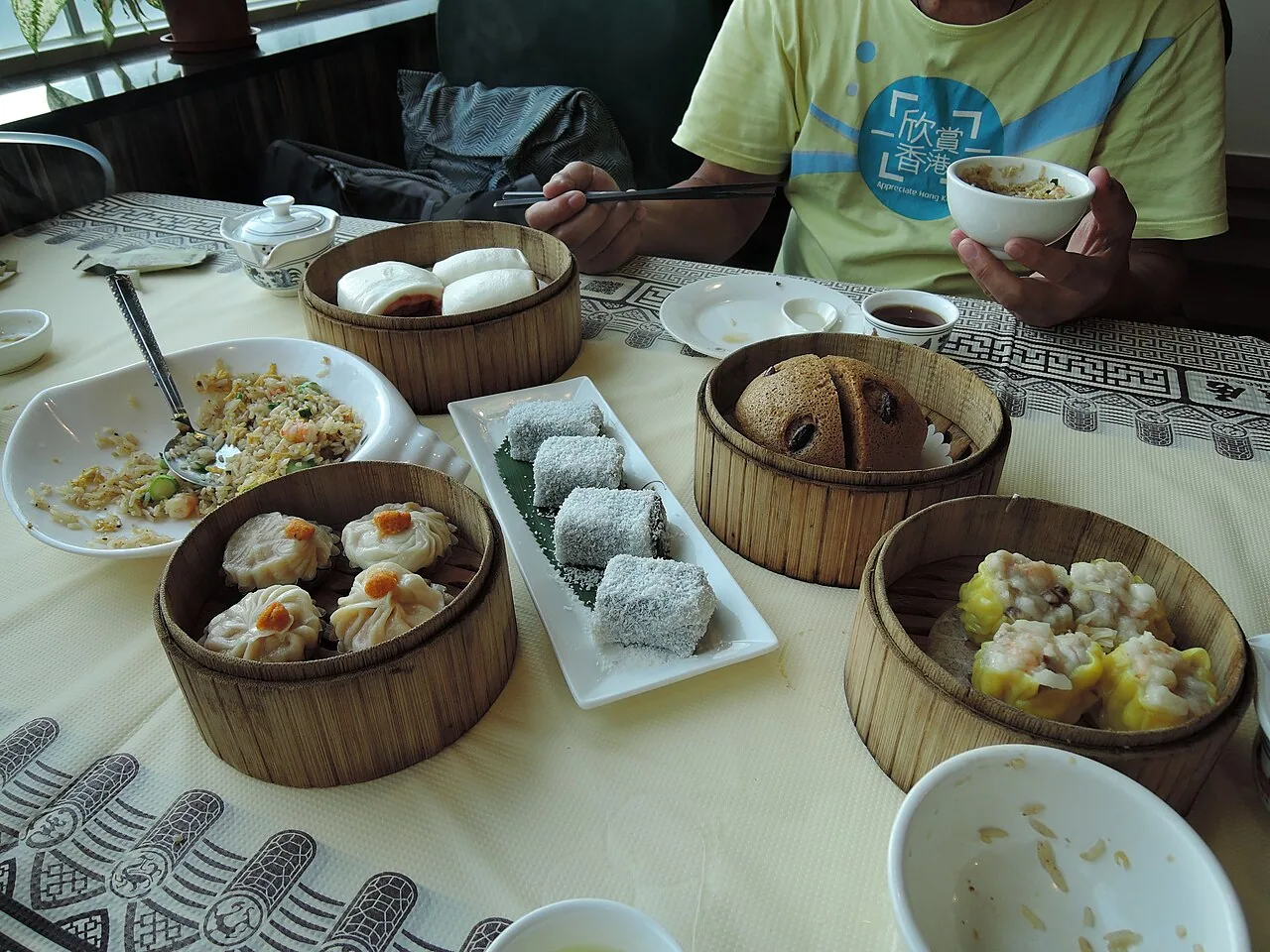
Yum cha (饮茶) means “drink tea”; dim sum is what you eat while doing it. Nobody here says “let’s get dim sum”, they say zaocha (早茶), morning tea. The sequence, if you have never done it:
Go early. Service starts when the doors open, often around seven, and the best items are gone before noon. Arrive at eleven on a Sunday and expect a ticket number and forty minutes.
Tea comes first. You will be asked which one before anything else: pu’er (普洱, dark and earthy, the safe default), tieguanyin (铁观音, lighter oolong) or chrysanthemum (菊花, floral, no caffeine). There is a per-head tea and table charge, generally around ¥5–15.
Two taps. When someone fills your cup, tap two fingers on the table — thanks, without interrupting whoever is talking. When the pot runs dry, tilt the lid open or rest it on the rim. Staff spot that from across the room.
Rinse. Most tables get a basin of hot water for washing your bowl, cup and chopsticks. Habit rather than hygiene now, but do it.
Order in waves. Paper slip and pencil, or increasingly a QR code. Three or four dishes a head is a full meal — order half, eat it, then order again, because steamed things go cold fast.
The bill is asked for. It never arrives on its own; say maidan (买单) or mime writing in the air. Splitting is normal among friends and not normal if you were invited.
What to order, and what good tastes like
- Char siu (叉烧) — barbecued pork, with a lacquered, faintly burnt edge, a seam of fat gone soft rather than chewy, and honey that stops short of sweet. Ask for banfei shou (半肥瘦), half fat half lean; ordering it pure lean is a mistake people make once.
- Har gow (虾饺) — steamed prawn dumplings. The wrapper should be translucent enough to see pink through, holding together when lifted and giving way when bitten. Whole prawns that snap; paste means corners cut.
- Siu mai (烧卖) — open-topped pork and prawn dumplings, coarser than the Shanghai kind, finished with roe or mushroom.
- Cheung fun (肠粉) — rice sheets steamed thin, rolled around prawn, beef or char siu, then flooded with sweet soy. The Shunde version, chen cun fen (陈村粉), is thinner and served flat.
- Roast goose (烧鹅) — the dish to travel for. Skin like glass, rendered fat beneath, dense slightly gamey meat, sour plum sauce alongside. Lower half (下庄) for meat, upper (上庄) for skin.
- Steamed fish (清蒸) — whole, eight to ten minutes, then hit with hot oil, soy and shredded ginger and spring onion. A good kitchen times it to the gram. The cheek is the best bite, and it goes to the eldest person at the table.
Chaoshan beef hotpot, explained
The broth is plain: beef bones, a few slices of daikon, sometimes corn. No chilli. This is not Sichuan hotpot and the soup is not the point — the beef is, and it arrives raw, hand-cut to order. If there is a man behind glass with a cleaver, you are in the right place.
The cuts are the whole discipline, and the menu usually prints a dip time beside each:
- 吊龙 diaolong — long loin strip, the all-rounder, roughly 8 seconds.
- 嫩肉 nenrou — tender lean, the quickest, around 5 seconds.
- 匙柄 chibing — “spoon handle” from the shoulder blade, a line of tendon through the middle, around 10 seconds.
- 五花趾 wuhuazhi — five-flower tendon from the shank, marbled with connective tissue. The most interesting cut and the one to order; roughly 15–20 seconds.
- 手打牛肉丸 — hand-pounded beef balls, and the one thing here you can happily overcook.
Go lean before fatty, a few pieces at a time. The dip times are not decorative — past about twenty seconds these cuts turn to rope. The sauce is shacha (沙茶), a Chaoshan paste of dried fish, shallot, garlic and peanut; take it neat and do not dilute it. Finish by dropping daikon and noodles into what is by then a very good broth.
Seafood, and the tank
Seafood restaurants run on a system that is entirely fair and entirely easy to get wrong. You pick from the tanks, it is weighed in front of you, you are told a price per jin (斤, 500g), and you choose a cooking method. The bill is weight times unit price, plus a cooking fee.
- Ask for the weight and the per-jin price out loud before it goes to the kitchen. Doing the sum on your phone in front of the staff is normal here.
- Rates vary enormously by species — a farmed grouper and a wild one are different animals at very different prices. Ask which you are being shown.
- The cooking fee (加工费) is legitimate, around ¥30–80 a dish. Confirm whether it sits inside the number you were quoted.
If a price sounds wrong for what you are pointing at, point at something else. Methods worth knowing: 清蒸 qingzheng, steamed plain, for a good fish; 白灼 baizhuo, blanched, for prawns; 蒜蓉 suanrong, garlic, for scallops and razor clams.
Cantonese restaurants close between services. Plenty of the good rooms stop in the middle of the afternoon and do not reopen until early evening, so trying to eat at four is a reliable way to have a bad day. Check the hours before you set out and keep a hotel restaurant in reserve — those tend to run straight through.
Ordering without Chinese
Less of a barrier than people expect. Most mid-range restaurants and every chain now order by QR code: scan the code on the table, a mini-programme opens inside WeChat or Alipay, and you tap through photographs, which solves most of the problem. Get WeChat and Alipay working first — there is no other way to pay. Older teahouses use paper slips, and a few still push trolleys, which is the easy version: look, point, nod. Six phrases that earn their keep:
- 不要辣 bú yào là — no chilli.
- 半肥瘦 bàn féi shòu — half fat, half lean, for char siu.
- 多少钱一斤 duōshao qián yī jīn — how much per jin, at the tank.
- 买单 mǎi dān — the bill.
- 打包 dǎ bāo — to take away.
- 少油 shǎo yóu — less oil.
Do not expect English menus outside hotels. The app locals pick restaurants with is Dianping (大众点评) — no English, but the photographs, price averages and queue tickets work without reading a word.
What it should cost
Per person, food and tea, no alcohol. All estimates.
- Chain dim sum on a weekday morning: around ¥50–80.
- Destination dim sum at a Black Pearl-listed room: ¥150–350, more if you order the expensive plates.
- Chaoshan beef hotpot: around ¥120–180, sauce and noodles included. Hard to spend much more.
- A neighbourhood Cantonese dinner for four with a steamed fish and a roast meat: roughly ¥120–200 a head.
- A tank seafood dinner where somebody orders a big grouper: ¥300–450 a head, and it can run well past that.
- Hotel Cantonese and the fine-dining end: ¥400 to ¥1,200.
Two structural savings. Lunch is cheaper than dinner at essentially every serious restaurant, and dim sum lunch in a hotel dining room is the best value in Cantonese food here by a distance. Second, several dim sum houses discount early weekday service, and Golden Imperial Court in Futian is the sharpest example I know of — but check the timing with the restaurant itself, since these offers get revised quietly.
Trabaja conmigo