Last verified:
Shekou is the one part of Shenzhen you can describe to a stranger in a single sentence: a peninsula in the far south-west of the city, pinned between a wooded mountain and the water, where China’s first reform-era industrial zone was drawn on a map in 1979 and a foreign community quietly settled in around it. Forty-odd years later it is still the place most new arrivals are sent, and still the place a fair number of them never leave.
What Shekou actually is
Administratively, Shekou is not a district. It is a sub-district at the southern tip of Nanshan, and if you tell a taxi driver “Nanshan” when you mean Shekou you will end up twenty minutes north in the tech blocks. Locally, though, it behaves like its own town: people say they live in Shekou, work in Shekou, and grumble about leaving Shekou.
The character of the place comes from its age. China Merchants started clearing ground here in 1979, which by Shenzhen standards is ancient history, and the housing stock reflects it. You get low- and mid-rise compounds with mature trees, real shade, older lifts, and generous balconies — a texture that most of the city, built two decades later in thirty-storey slabs, simply does not have. The working port is still there, container cranes visible from the promenade, and it gives the neighbourhood a slightly maritime, slightly unglamorous edge that I like.
The places worth your time
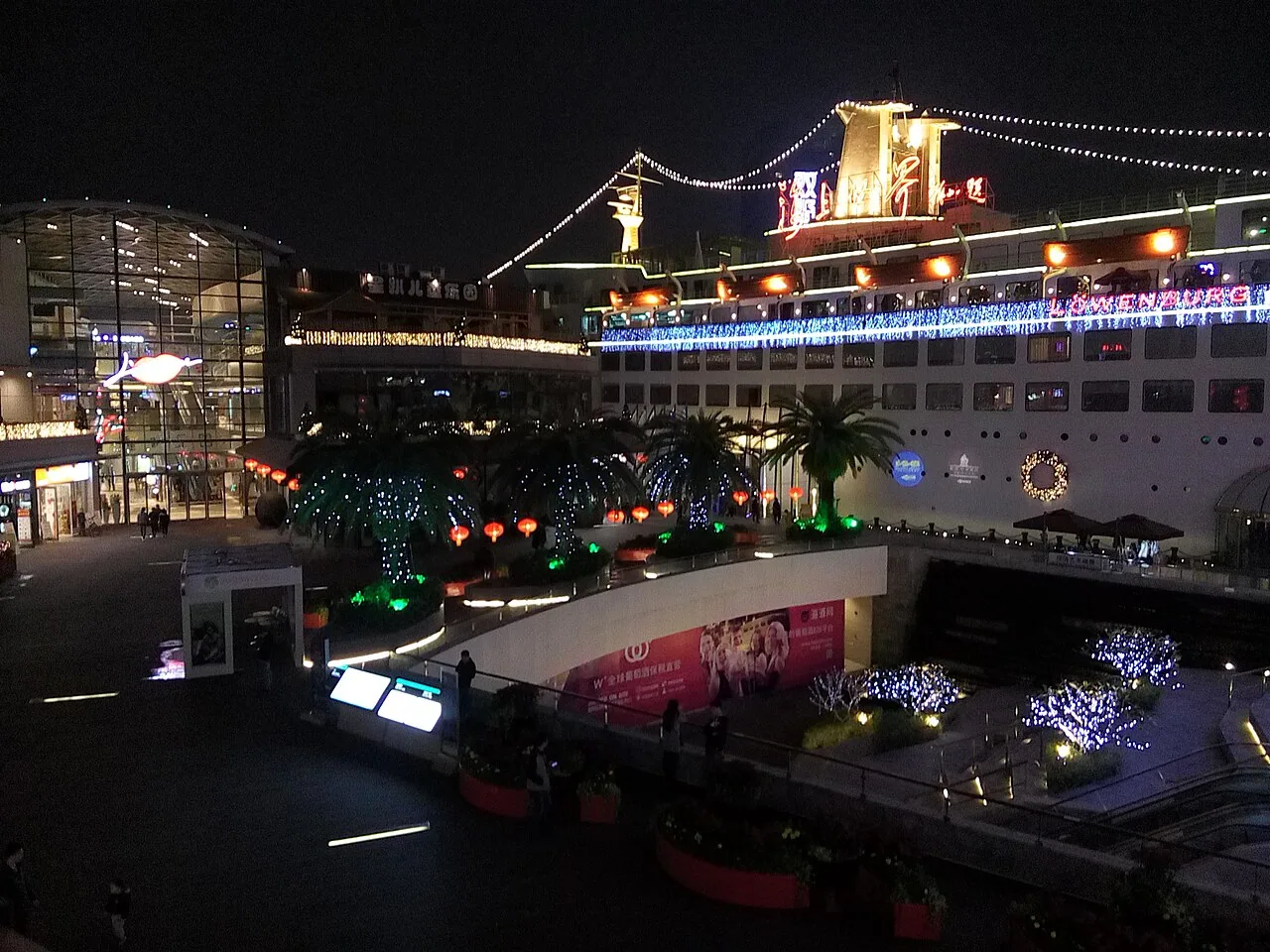
Start at Sea World (海上世界), the pedestrian plaza built around the Minghua (明华轮), a French-built ocean liner that was beached here in the 1980s and turned into a fixture rather than scrapped. Restaurants and bars ring the square, there are evening fountain shows, and on a Friday night it is the closest thing western Shenzhen has to a village green. It is also the single most crowded spot in the neighbourhood at weekends — go on a Tuesday if you want to hear yourself think.
Two minutes’ walk toward the water is the Sea World Culture and Arts Center (海上世界文化艺术中心), the Fumihiko Maki building that opened at the end of 2017. It runs design and photography exhibitions, has a good bookshop and café, and the roof terrace is one of the better free views in the city. Check what is actually on before you make the trip — between shows, half the galleries close.
Behind all of it is Da Nanshan (大南山), a little over 300 metres of hill with several stair routes to the top. Entrances at Sea World, off Yanshan Road, and near the villa compounds all lead to different climbs, so pick yours before you leave the house — they do not conveniently connect at the bottom. It is steep, largely stepped, and in summer it is brutal after about nine in the morning. Go at dawn, bring more water than you think, and you get the port, Shenzhen Bay and Hong Kong’s hills laid out in one sweep.
Westward the peninsula ends at Chiwan (赤湾), the Line 2 terminus, where you will find the restored Qing-era gun battery at Zuopaotai and the Tin Hau temple — a quiet, genuinely old corner that almost no one visits. Eastward, the coastal promenade runs from Shekou along Shenzhen Bay for many kilometres toward the mangroves. Do not try to walk all of it; pick a two- or three-kilometre stretch and finish near a metro station. For the newer waterfront around Taiziwan, K11 ECOAST and Garden City, the detailed Shekou section on the Areas page has the addresses and access notes.
Schools, and why families concentrate here
The honest explanation for Shekou’s foreign population is not the sea view. It is that three of the city’s established international schools — Shekou International School (SIS), QSI International School of Shenzhen, and Shenzhen American International School (SAIS) — sit within a few kilometres of each other, and families rent around them.
Before choosing a compound, compare Shenzhen international-school fees, curricula and locations, then use the guide to choosing a Shenzhen family neighborhood against the actual school-bus route.
A few practical points. Most schools of this type in China require a foreign passport or non-mainland ID for the child, and the rules on eligibility are set by the education authorities rather than the school. They are also revised from time to time, so confirm your own family’s situation with the school’s admissions office and the current official guidance from the municipal education bureau before you commit to anything. Places at the popular year groups go early; assume you are applying a year ahead, not a month. And fees are the largest single line in a Shekou budget by a distance — ask the school directly for the current schedule rather than trusting a forum post.
Sign the school place before you sign the lease, not the other way round. I have watched more than one family commit to a flat, then discover the bus route they assumed existed does not serve their compound.
Living there: rent, and the parts nobody advertises
Broad estimates, and they move with the market — treat these as a starting bracket, not a quote. A one-bedroom in an older Shekou compound tends to run around ¥4,500–8,000 a month. Two bedrooms in the same sort of building, roughly ¥8,000–14,000. A three-bedroom family flat in one of the newer developments closer to the hillside is commonly ¥15,000–25,000, and the newest towers ask management fees several times what the 1990s compounds charge. Older buildings buy you space and trees; newer ones buy you a lift that works and a gym. Both are more expensive than the equivalent in Bao’an or Longhua, sometimes substantially. My general guide to leases, deposits and agent fees is in renting an apartment in Shenzhen.
Now the downsides, because a guide that only praises is an advertisement. Shekou is a bubble — a pleasant one, but a bubble. English is widely spoken, which is convenient in month one and quietly corrosive by year three; if you want your Chinese to improve, this neighbourhood will happily let it not. You pay a premium for the postcode. The commute to Futian is real: expect 45–60 minutes door to door on Line 2, longer at peak, and if you work in Luohu you should think hard. Weekends at Sea World are busy enough to be avoidable. The hillside brings mosquitoes and a damp that gets into cupboards from spring onwards. And the last trains go somewhere around eleven — the exact time varies by line, station and direction, so check your own — which means a late night in the city ends in a taxi home and a fare to match.
Getting in and out
Line 2 runs the length of the peninsula — Chiwan, Shekou Port, Sea World, Shuiwan, Dongjiaotou, Wanxia — and is the spine of daily life here. Line 12, open since late 2022, adds Zuopaotai, Taiziwan, Sihai and Huaguoshan and runs north through Nanshan into Bao’an, which made getting to the western half of the city dramatically less painful. If you are still working out the system, start with the Shenzhen metro guide; and the Line 13 extension that opened in June 2026 has changed the western picture again, running north from the Shenzhen Bay border crossing toward Guangming.
Hong Kong and Macau
The nearest land crossing is Shenzhen Bay Port (深圳湾口岸), typically 15–25 minutes by car from Sea World depending on traffic, with cross-boundary coaches into Hong Kong leaving from the terminal itself; since the Line 13 extension it is also reachable directly by metro. Plan a late return around published closing times rather than hope. The pedestrian crossings at Futian and Luohu both shut for part of the night, and the rebuilt port at Huanggang — the one people keep telling you is about to open — has not opened, with no date announced. Port hours and border rules have changed more than once in recent years, so confirm the current ones with the official Shenzhen government and Hong Kong Immigration sources before you commit to a late crossing, and check your own re-entry permission for the mainland side too.
The other option is the water. Shekou Cruise Homeport at Taiziwan runs ferries toward Hong Kong International Airport, Hong Kong Island, Macau and Zhuhai. The airport service is the useful one: passengers connecting onward can often be transferred to the airside terminal without formally entering Hong Kong, which turns an ugly journey into a civilised one. That depends on your airline taking part in the scheme, so confirm it when you book rather than assuming it. Routes and sailing times here have been suspended, resumed and re-timetabled repeatedly since 2020, sailings are only a handful a day, and rough weather cancels them — check the operator’s own current schedule the week you travel and do not build a tight connection around a timetable you read online months earlier.
Shenzhen Bao’an Airport is roughly 40–55 minutes by car, more in the evening peak. Onward notes are on the Bao’an page.
Eating and drinking
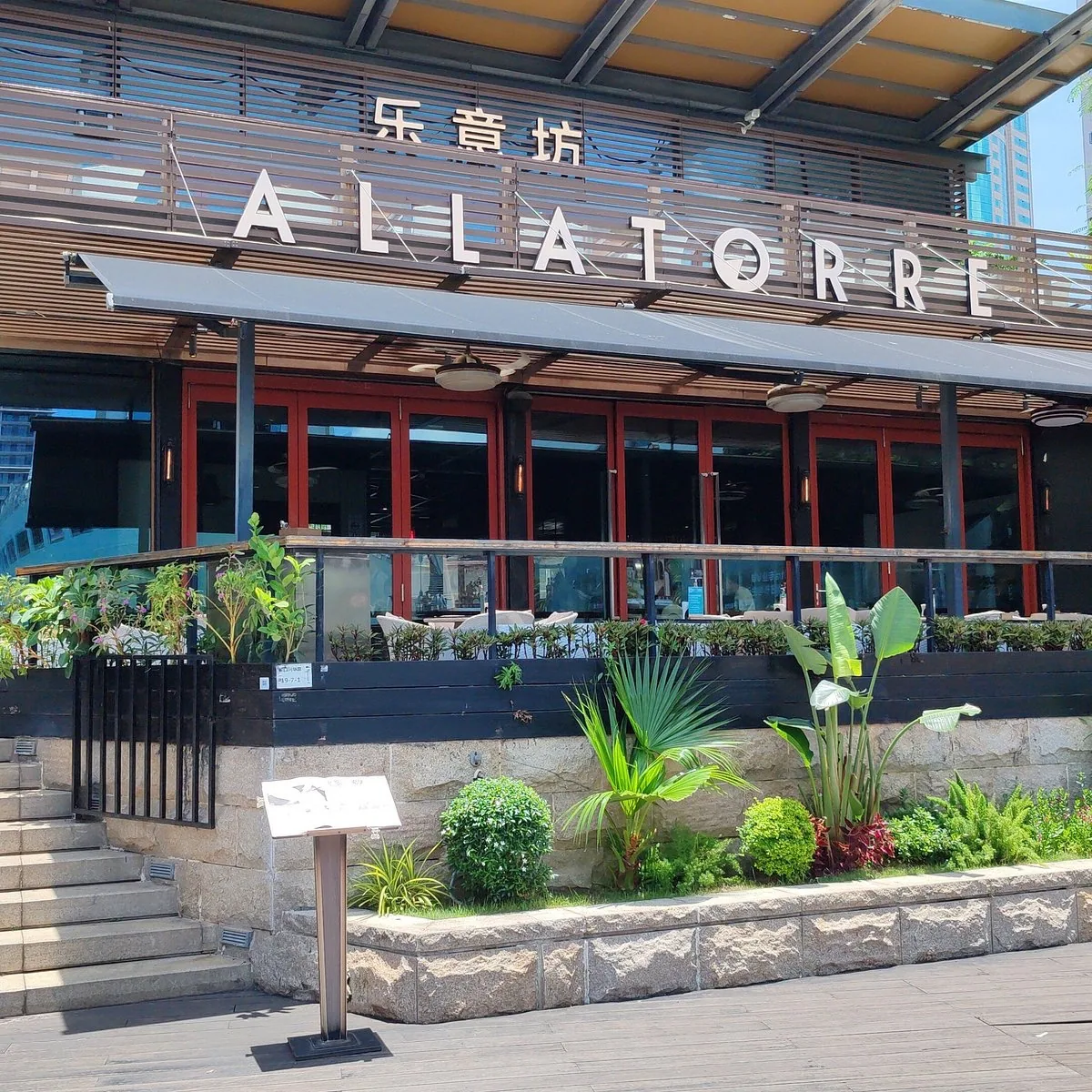
The Sea World strip is where the international kitchens cluster. Alla Torre does proper wood-fired pizza and handmade pasta, and a full sit-down dinner there is one of the pricier meals in the neighbourhood — broadly ¥200–350 a head once wine is involved, considerably less if you stop at pizza. Gaga is the reliable brunch, salad and fresh fruit tea stop, and comfortably cheaper. Commune Museum runs all day from coffee into cocktails with the water in front of it. Villa, five minutes up the hill, is a dining room downstairs and an open-air terrace bar above, and it stays open late. Around them are the long-running pubs, a scattering of Korean, Japanese and Thai places, and enough terrace seating that from October to April you can eat outside almost every night. Every figure here is a bracket rather than a menu — prices on the strip move, and the plaza rents move with them.
One correction to the usual advice: Shekou is not only western food. The Cantonese and Chaoshan restaurants in the older blocks off Nanhai Avenue are better value and often better cooking than the plaza, and the seafood near the port is worth a detour. More across the city on the restaurants page.
So who is it for?
Shekou suits families with children in the international schools, anyone working in Nanshan or Qianhai, people who want to swim, run or climb something before work, and newcomers who need a soft landing while they find their feet. It suits short postings very well.
It suits you less if you commute daily to Futian or Luohu, if your budget is tight, if you came here to learn Chinese and live locally, or if you want a dense city with things happening after midnight. Shenzhen has all of that — just not on this peninsula.
If you want a day walking the neighbourhood, seeing flats and schools with someone who lives here, that is exactly what I do.
Work with meWhere you would actually go if someone is ill
Shekou is the one part of the city where you can reasonably expect to be treated without crossing a district, and the naming is the trap.
Shenzhen Qianhai Shekou Free Trade Zone Hospital 深圳市前海蛇口自贸区医院 — tertiary, founded 1955, at 128 Gongye 7th Road. Despite Qianhai in the name it is physically in Shekou, and it is still signposted as Shekou People’s Hospital — both names are current and neither is defunct. It has an emergency department and its own ambulance line. This is the one you can reach without leaving the peninsula.
Nanshan District People’s Hospital 深圳市南山区人民医院 — Grade-A tertiary at 89 Taoyuan Road — in Nanshan District but about seven kilometres north of Shekou. A taxi, not a walk. This is the higher-grade fallback when the case is serious enough that capability matters more than proximity.
The University of Hong Kong–Shenzhen Hospital 香港大学深圳医院 — Grade-A tertiary with a named international department — but it is in Futian, a cross-district journey east. Right for a planned consultation in English; wrong as an emergency destination from Shekou.
Shenzhen New Frontier United Family Hospital 深圳新风和睦家医院 — private, JCI-accredited, 24-hour emergency room and insurance direct billing. Also worth stating plainly: it is on Fuqiang Road in Futian, not in Shekou, however often it is described as the Shekou expat hospital.
How healthcare works here, in full — insurance, hospital tiers, and what social insurance does not cover.