Last verified with Shenzhen Government source:
Getting to Hong Kong is easy; getting there efficiently takes one decision, made before you leave the flat. The mistake I see most often is choosing the port nearest to where you are standing rather than the one nearest to where you are going — routinely an hour’s difference. The second is arriving with everything you need to get into Hong Kong and nothing that gets you back.
Pick the port before you pick the taxi
Six ways across are in service. Which one suits you falls out of two questions, and only two: how much you are carrying, and where in Hong Kong you actually need to end up.
- A backpack, heading for Kowloon or the Island — Futian Checkpoint on foot, or the high-speed train from Futian station if you would rather pay for the speed.
- Starting in Luohu, or stepping off a mainland train — Luohu, and only then.
- A suitcase, a pushchair, or Hong Kong airport — a through-coach over the Shenzhen Bay bridge.
- Flying out of HKIA from the west of the city — the Shekou ferry, if the sailing times line up.
- Driving, or bound for the eastern New Territories — Liantang.
- Huanggang — not open. Read the section below before you plan around it.
Every duration on this page is a planning figure of my own rather than an official one, and opening hours at these ports have been revised more than once in recent years. Confirm the current hours with the official source before any late or tightly timed crossing.
Walking across: Futian and Luohu
Futian Checkpoint 福田口岸
My own default, and the one I recommend to almost everyone who asks. Metro Lines 4 and 10 both terminate in the basement, so you arrive already inside the building rather than outside it. From there it is a covered walkway over the river, mainland counters at one end and Hong Kong counters at the other, and you surface at Lok Ma Chau — the first station on the MTR's East Rail Line, which threads down through Kowloon Tong towards the harbour. Reckon on something like half an hour for the two clearances outside the rush, and roughly as long again on the train before you are anywhere useful. Nothing on wheels uses this port, which is precisely why it moves. Published hours have sat in the region of 06:30 to 22:30, but the deadline that will actually catch you is the last northbound train out of Hong Kong, not the shutters here. If you live in Futian, you can stop reading at this paragraph.
Luohu 罗湖口岸
The original crossing, and the one most people picture when they think of the boundary at all. Its virtue is pure adjacency: the hall sits directly above Luohu metro station on Lines 1 and 9, a covered walk from Shenzhen railway station, so anyone arriving on a mainland service can be in the queue within minutes of getting off. Its vice is where it puts you down — Lo Wu, the terminus at the far northern end of the East Rail Line, a good few stops adrift of where Futian leaves you — and that it absorbs the heaviest pedestrian flow anywhere on the boundary. Hours here have run later than Futian's, nearer midnight than late evening, which is occasionally the deciding factor. Use it if you are already in Luohu. Crossing the city to reach it undoes the point.
Shenzhen Bay, coaches and cars
Shenzhen Bay Checkpoint 深圳湾口岸
The western land port, at the mainland end of the bridge across the bay, and the least unpleasant of the three if you are carrying anything at all. What sets it apart is the layout. Instead of clearing one authority's counters, walking, and then clearing the other's, you do both inside a single terminal on the Shenzhen side — 一地两检 in the official shorthand. The number of queues is unchanged. What you are spared is the walk between them, which matters more than it sounds in August, or with a tired child attached to you. Metro Line 13 has its southern terminus at the checkpoint, so most of Nanshan can reach it without a taxi; the extension that opened at the far northern end of that line in June 2026 means the same train now continues up towards Guangming, but it did not change anything about getting to the border itself.
Coaches and airport shuttles
This bridge is also where the cross-boundary coach network runs, and for a lot of families it is the only sensible answer. Operators pick up at hotels and transport hubs across Futian and Nanshan and run through to Hong Kong airport, Kowloon and the Island. The mechanics catch first-timers out: you are set down at the checkpoint, walk your own bags through both sets of counters, and then rejoin the same coach on the far side, which waits for its passengers. Fares have generally sat in the low hundreds of yuan and vary by operator and destination, so check the price when you book rather than assuming. Around mainland holidays reserve a day ahead, and treat the door-to-door time as nearer three hours than one.
Liantang 莲塘口岸
The newest of the land crossings and the one nobody mentions, out at the eastern edge of the city and connecting to Heung Yuen Wai on the Hong Kong side. It was built mainly with freight and vehicles in mind, and that is still its character. For a pedestrian heading into Kowloon it is the wrong answer by a wide margin. For anyone driving, or aiming at the eastern New Territories rather than the urban core, it is the obvious one. Taking a private car across the boundary in either direction is a separate undertaking with its own permits and plates, and not something to improvise on the day.
By water, and by rail
The Shekou ferry
Boats leave Shekou Cruise Homeport 蛇口邮轮母港 for the ferry terminal at Hong Kong International Airport, for the city itself, and for Macau and Zhuhai. Roughly half an hour on the water gets you to the airport, and that is the whole appeal — no bridge, no coach, no traffic, and a seat the entire way. The catch is frequency and weather: only a handful of departures a day, and rough conditions cancel them outright, so look up the operator's timetable the evening before instead of turning up hopefully. On the airport service, passengers flying onward can usually finish check-in and hand over their hold bags at Shekou, then reach the departure gates without formally clearing Hong Kong immigration — a genuinely different experience from a land port. It is not universal, since it depends on your airline taking part, so settle that when you buy the ticket. Fares have been in the region of a few hundred yuan. If you are in Shekou and flying out of HKIA, this is the option everything else has to beat.
The train to West Kowloon
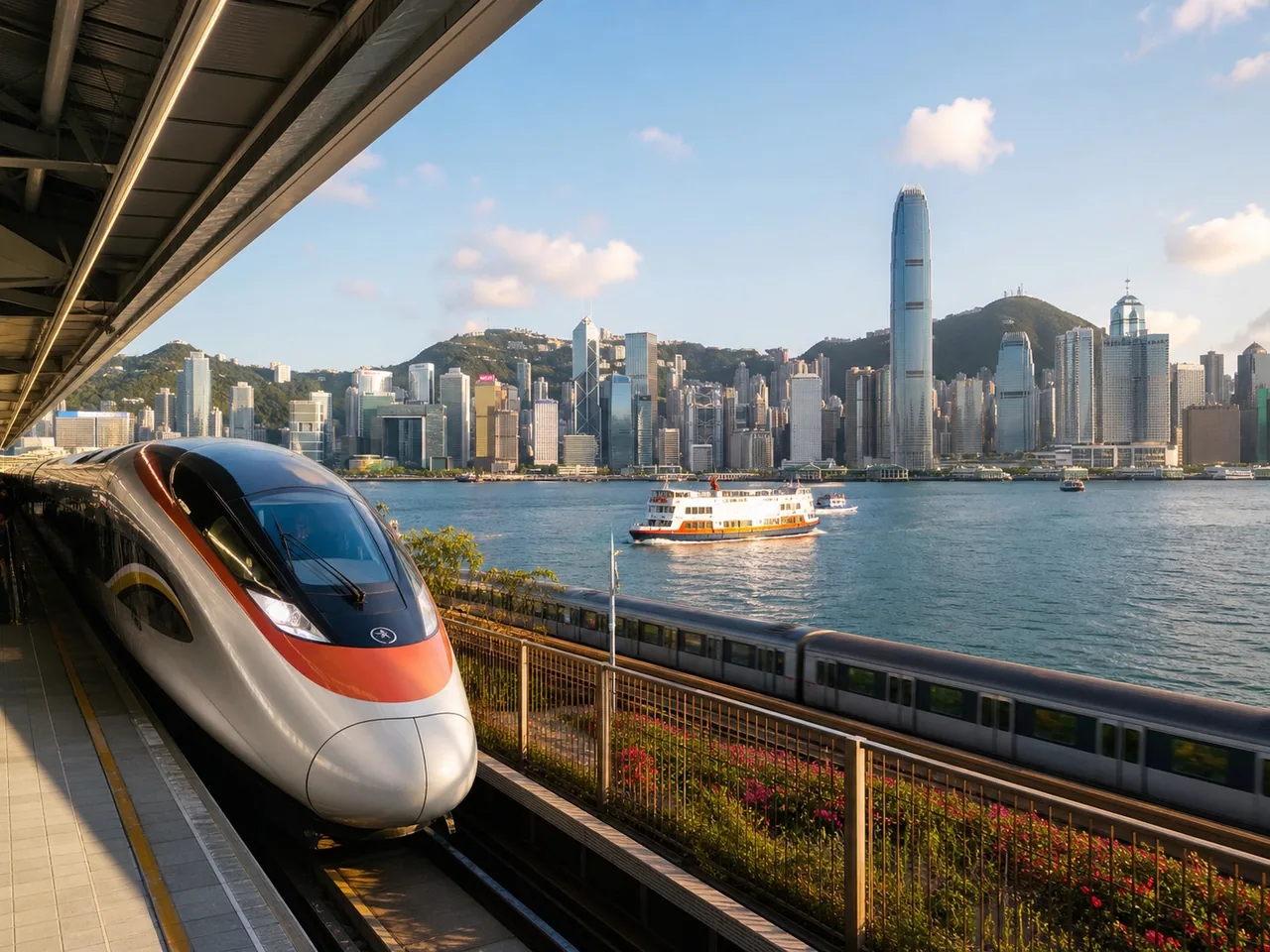
The Guangzhou–Shenzhen–Hong Kong high-speed line runs from Futian station — Lines 2, 3 and 11 sit above the platforms — to Hong Kong West Kowloon in roughly fifteen minutes. What makes it quick is the co-location arrangement: a defined part of West Kowloon station is designated a Mainland Port Area, where mainland officers exercise mainland powers. You board at Futian with nothing but a ticket and a security check, then clear mainland exit and Hong Kong entry back to back on arrival, without leaving the building. Northbound it reverses. Tickets are ID-based, booked on 12306 with the passport you intend to travel on. Second class has generally run around ¥70–90.
Huanggang has not opened
This question arrives often enough that it deserves an unambiguous answer. The rebuilt Huanggang port is not open. Neither government has announced a date for opening it. It is not processing passengers, and there is no phased or partial access to it. The reason the rumour keeps regenerating is that the visible parts look finished and the legal groundwork on the Hong Kong side is genuinely done — but a completed building and an enacted law are not an opening, and no timetable follows automatically from either. The concept behind it, a single joint inspection replacing the two separate ones described above, would be a real improvement on every crossing on this page if it ever carries passengers. I have set out what has actually been confirmed and what has not separately. Until an announcement exists, do not build a trip around it. One practical trap while you wait: Line 7 has a station called Huanggang Port, it is perfectly operational, and it does not take you to Hong Kong.
Documents: where people get caught
Hong Kong entry and mainland re-entry are two separate questions, and almost everyone plans only the first. Carry your passport; a photograph is worthless at a counter. Whether you may enter Hong Kong, and for how long, depends on your nationality — the Hong Kong Immigration Department ↗ publishes the current position for each one.
Coming back is what strands people. Leaving the mainland consumes an entry on whatever permission you hold: a single-entry Chinese visa is spent the moment you cross, and a double-entry gives you exactly one round trip. On a multiple-entry visa the date that matters is the visa’s own “enter before” date, not the stay granted on arrival. Residence permit holders re-enter freely while the permit is valid — with one exception: during a renewal your passport may sit at the exit–entry bureau for a week or more. Plan Hong Kong trips around your renewal cycle, not into it.
Visa-free and transit schemes have changed repeatedly, and transit arrangements generally assume onward travel to a third place — a Hong Kong round trip may not qualify. Check your own nationality’s position with the National Immigration Administration ↗ before travelling. Chinese passport holders and Hong Kong residents use the exit–entry permit system instead. Children need their own documents.
Re-entering the mainland restarts the clock on temporary residence registration, and a day trip to Hong Kong counts as re-entry. If you live in your own flat rather than a hotel, you need to re-register at the police station covering your address. Twenty-four hours is the figure usually quoted for urban districts, but what each station accepts in practice varies, so confirm the window with yours rather than assuming. The registration guide covers the process.
Queues, money and what you can bring back
When you go matters more than where you go. Southbound demand stacks up through the early weekday morning; the genuinely bad windows are Friday evening heading south and Sunday evening heading back, when everyone in the city has had the same weekend idea at the same time. Mainland public holidays are in a category of their own and can multiply anything I have written above several times over. A late-morning departure midway through the working week is a different border altogether, and it costs nothing to arrange.
Frequent travellers who qualify can register for the self-service e-Channel gates, which replace the counter queue with a few seconds at a barrier. Each side operates its own scheme with its own eligibility rules, and both have been revised over the years — check the current terms and who they apply to with the relevant immigration authority before counting on it.
Money and phones both stop working the way you expect the moment you cross. The mainland payment apps cover very little in Hong Kong; acceptance has been widening but remains far too uneven to depend on, so carry an Octopus card and some cash in Hong Kong dollars. The asymmetry runs the other way too — an overseas card that is useless in Shenzhen will be accepted almost anywhere in Hong Kong. Your mainland number will roam, and the bill accumulates faster than people expect; a package covering both sides is the tidy solution, and the SIM card guide lays out what is available. For which line serves which checkpoint, see the metro guide.
Two sets of customs rules catch people repeatedly, and both are worth checking rather than remembering. Hong Kong caps the quantity of powdered infant formula a departing traveller may carry out — the limit has stood for years at two tins for a traveller aged 16 or over, but confirm the current figure with Hong Kong Customs before you go shopping for anyone. In the other direction, mainland customs restrict fresh meat, poultry, eggs and fruit, and apply separate limits to alcohol, tobacco and cash carried without declaration. The duty-free allowance for personal items has sat around the five-thousand-yuan mark for a long time, but the detail is revised periodically and the penalties for getting it wrong are real, so confirm it with the official source rather than with whoever is selling you the goods.
Hours, allowances and visa policy all move, and none of them consult me first. The Hong Kong Immigration Department and sz.gov.cn ↗ outrank this guide, every time.
Work with me