Last verified:
Futian does not really have restaurant streets. It has towers, and the eating happens inside them — the fifth floor of a mall, the podium of a hotel you would never walk past by accident, the top of an office block. Once you stop looking for a street and start looking for a lift, the district gets much easier to eat in.
The malls are the restaurant streets
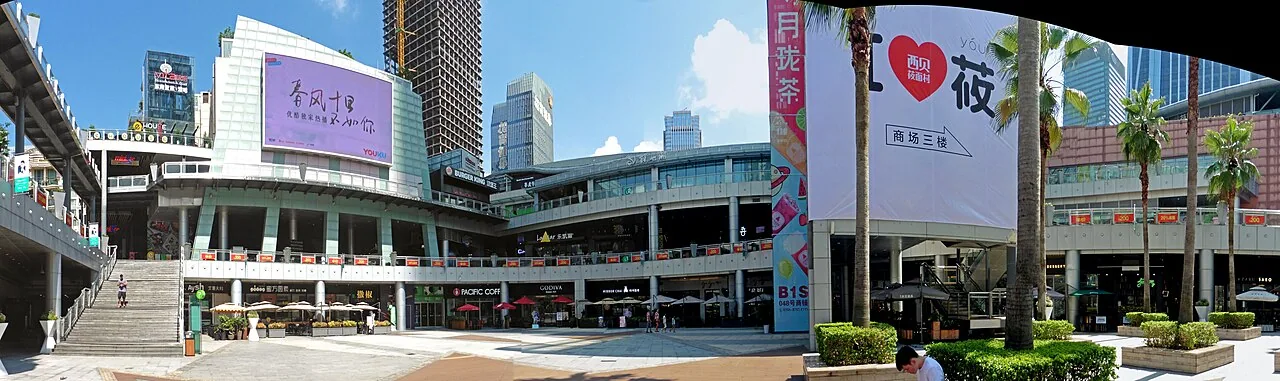
Almost every table worth booking in the CBD is inside a mall, a hotel or an office podium, and the layout repeats often enough to be a rule. Ground floor: luxury retail and a coffee chain. Middle floors: clothes. Top one or two floors: restaurants, a dozen or more of them off a single circulation ring. Basement: the food court, the supermarket and the metro entrance. If you are hungry and standing in a Futian mall, go up rather than along.
Three are worth knowing. COCO Park (购物公园) is the district’s default meeting point, and it has a metro entrance in its own basement, which is why nobody ever has to explain how to get there. Central Walk (中心城) is at the Convention and Exhibition Centre interchange — quieter, and better when you want to hear each other. UpperHills (深业上城) is on the eastern edge, where a lane of small bars sits underneath a luxury hotel and two of the more serious kitchens in the city. Worth saying plainly: the MixC malls people use as shorthand for good mall dining are in Luohu and Nanshan, not here. Futian’s equivalents are those three, plus the podium floors of Ping An Finance Centre and Zhuoyue Centre.
One practical consequence, and it catches people out. Plenty of mall restaurants here do not take evening reservations at all — you scan a code at the door, take a number and wait. The system is at least honest, but on a Saturday evening the wait can be long enough to change your plans. Arriving before six rather than after is the whole trick. If you want the district itself — the interchanges, the parks, what it is like to live in — that is the Futian district guide.
Hosting a dinner in the CBD
Futian is where Shenzhen’s expense-account dining happens, so a fair number of people reading this are booking a table rather than choosing one. The full etiquette — seating, toasting, who orders — is set out on the fine dining page and there is no sense repeating it here. What follows is the part that is specific to this district.
- Private rooms are the CBD’s currency. Ask for a 包间 (bāojiān) when the conversation matters. Nearly every restaurant at this level has them and nearly all attach a minimum spend, which varies enormously by room and by night — get the number confirmed at the point of booking rather than discovering it on the bill.
- Lead time here is longer than you think. A few days will usually secure a midweek room; a weekend needs more; the tasting menus need a couple of weeks or more. Ranges, not promises — the good rooms move with the season and the calendar.
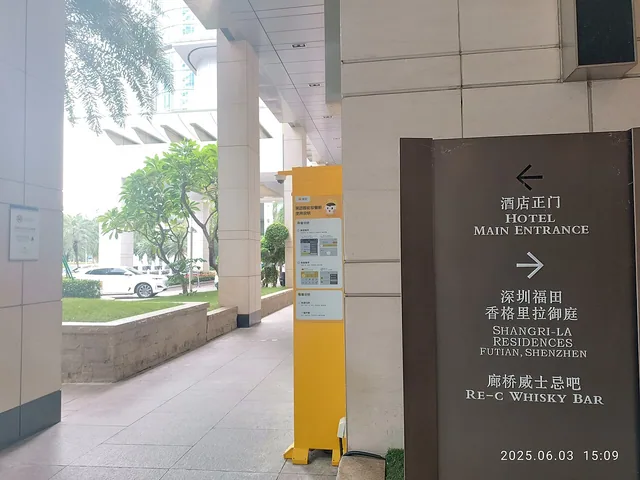
- The tower is not the restaurant. Hotel and office-tower kitchens often have their own lift bank and their own entrance, sometimes on a different side of the building from the lobby. Ask which door when you book, and give yourself ten minutes at the bottom of the tower.
- It all runs through WeChat. The booking, the queue number, the menu and the bill. Get WeChat Pay working before you try to host anything. If it is not working yet, ask a hotel concierge to make the call — that is not a workaround, it is the job.
The serious end
Most of the city’s ambitious cooking is in Futian, and it is concentrated into roughly half a dozen addresses rather than spread across the district. Ensue sits on top of the Futian Shangri-La. Xin Rong Ji is in Ping An Finance Centre. The Mandarin Oriental’s Cantonese room and Voisin Organique are both at UpperHills. The Grand Hyatt has its own Cantonese dining room, and Zhuoyue Centre has the vegetarian outlier. Some of that is walkable; UpperHills to Ping An is a taxi, not a stroll.
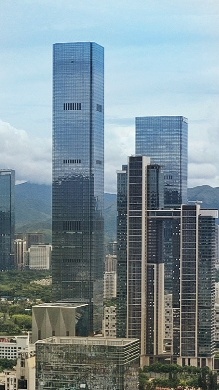
What that means in practice is that the top of the market here is hotel-shaped, which is convenient if you are visiting and staying in one of those towers anyway. The buildings themselves are on the hotels page, and the wider tasting-menu list — including the rooms out in Nanshan and Shekou that justify the taxi — is on the fine dining page. For Cantonese specifically, from the hotel dining rooms down to the cheap teahouses, there is a Cantonese page as well. Chefs, menus and awards all change; confirm on the venue’s own WeChat account before you build an evening around any single dish.
Lunch, and what it all costs
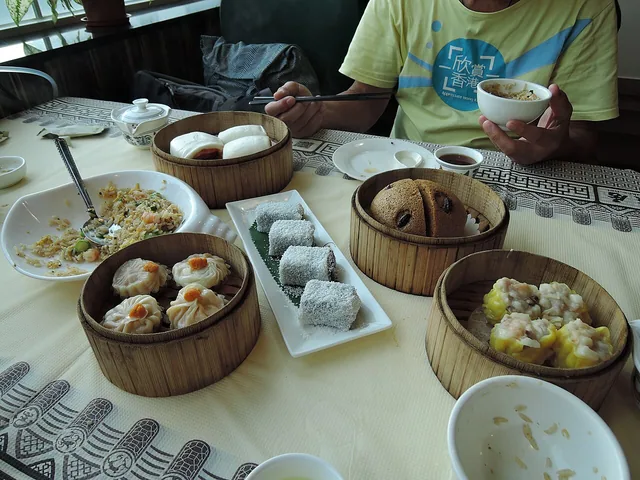
Lunch in the CBD runs from late morning to around one, and for that hour the restaurant floors fill with the same lanyards you saw in the lift. Sets are the standard format — a main, rice, soup and a drink. Hotel restaurants run executive lunch sets that are usually the cheapest way to eat their cooking, and a dim sum lunch at a hotel Cantonese room will often cost well under what dinner does while showing you more of what the kitchen can actually do.
Rough per-person figures for the district, with a drink. These are estimates rather than quotes — prices in Shenzhen move, and a tasting menu with wine is a different animal from the same menu without.
- Basement food court: around ¥25–45
- Mall lunch set: around ¥40–70
- Proper dim sum: around ¥70–180
- Casual dinner with a beer: around ¥120–250
- Hotel Cantonese or modern Chinese: around ¥400–900
- Tasting menu at the top: around ¥1,200–1,800
Hotel restaurants commonly add a service charge in the region of ten to fifteen per cent. Read the bottom of the menu before you decide the bill is wrong, and expect a deposit if you are booking a private room or a set menu.
Reviews here live on Dianping (大众点评), not on the English apps. The user photographs are current and the ratings are worth reading. The English-language listings for Shenzhen tend to lag badly and still carry places that have closed — if you cannot read the app, the length of the queue at seven in the evening is a better proxy than any star rating you will find in English.
After work, and after that
The eastern end of COCO Park is the CBD’s drinking block: terraces, sports bars, a couple of clubs, and on a Friday night one of the denser crowds in the city. On a Tuesday the same block is close to empty, which some people prefer. Craft beer has spread across the district over the last few years and most malls now have a taproom somewhere on the restaurant floor. The quieter alternative is a hotel bar — the towers along the central axis all have one, generally high up and priced accordingly.
Late in the evening the CBD empties fast, and what stays open is Xiasha (下沙), a couple of stops east. It is one of the urban villages the CBD grew around rather than over: tight lanes, tanks of live seafood, hotpot and outdoor grills running long past the point at which the towers have gone dark, at a fraction of tower prices. Go with someone who reads Chinese, or choose the place from the Dianping photographs rather than from an English map app. Work out how you are getting home before you commit to the evening — the last-train times are in the metro guide, and DiDi is the fallback. And if you want the other kind of night, outdoors and near the water, that is Shekou, out west.
Work with me