Last verified:
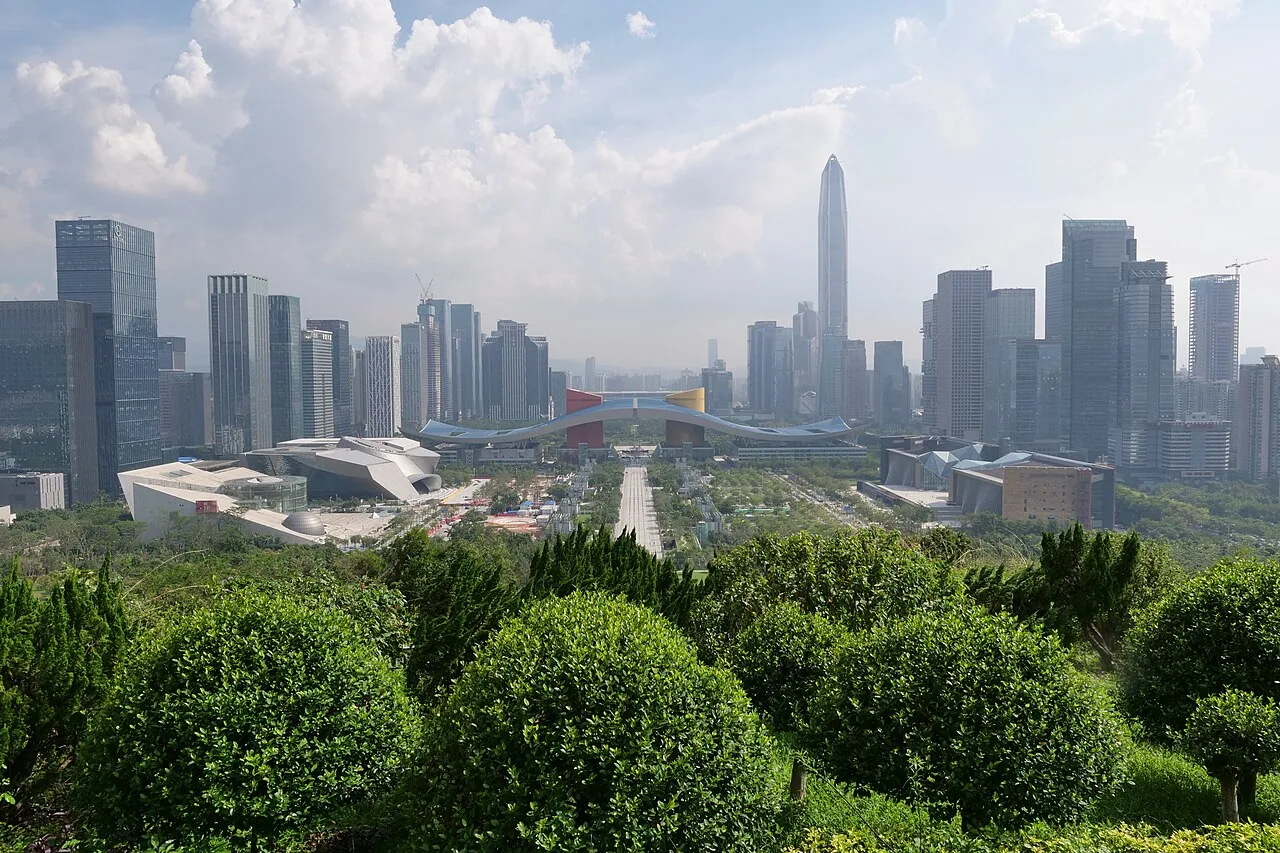
Futian is the district Shenzhen built on purpose. Luohu grew out of a border crossing and Nanshan grew out of a university and a port, but Futian was drawn on a plan — a north–south axis running from the hills down through the government building to the sea, with the tallest tower in the city parked halfway along it. Living here feels like that: legible, convenient, and rarely quiet.
The shape of the district
Futian runs from the Hong Kong border in the south up to the hills at Meilin and Bijiashan in the north. Most of what people mean when they say “Futian” is a much smaller box: the CBD between Fuhua Road and Shennan Boulevard, four or five metro stops wide. That box holds the Civic Center, the Convention and Exhibition Center, Ping An Finance Center, two of the better malls in the city, and the underground station that puts you in Hong Kong in about a quarter of an hour.
Step outside it and Futian is far more ordinary than the skyline suggests. Xiasha and Shangsha are dense former villages with cheap food and small flats. Meilin and Xiangmi Lake are residential and comparatively green. Huaqiangbei, the electronics market, is Futian too, and feels like a different city entirely. That contrast is the thing to understand before you sign anything: you can live in Futian for ¥4,000 a month or ¥40,000, sometimes within a kilometre of each other.
The places worth your time
Ping An Finance Center
At 599 metres, Ping An Finance Center (平安金融中心) is the tallest building in Shenzhen and the one every photograph of the city is either taken from or aimed at. The observation deck, Free Sky, is on the 116th floor. Adult tickets have sat in the low hundreds of yuan, but the price and the opening hours both change — check the official channel on the day rather than trusting a figure you read somewhere. Check the forecast too before you commit: on a hazy day you are paying to look at grey. Book through the official channel rather than a reseller, and bring your passport. The mall in the podium is unremarkable: go up, then leave.
The Civic Center and Lianhua Hill
The Civic Center (市民中心) is the long building with the wave roof, and it houses Shenzhen Museum’s history galleries. Entry is free, but like most public museums here it generally wants a booking made in advance through a WeChat mini-programme — do it the day before and carry your passport. Booking rules and closing days get changed without much warning, so confirm on the museum’s own channel before you build an afternoon around it. Directly north, Lianhua Hill Park (莲花山公园) is a twenty-minute climb to a bronze Deng Xiaoping and the best free view in the district: the whole central axis laid out below you with Ping An at the end of it. Go at dusk. The kite lawn on the way up is one of the more genuinely pleasant things in central Shenzhen. Aim for Children’s Palace (Lines 3 and 4) or Civic Center (Lines 2 and 4).
COCO Park and Central Walk
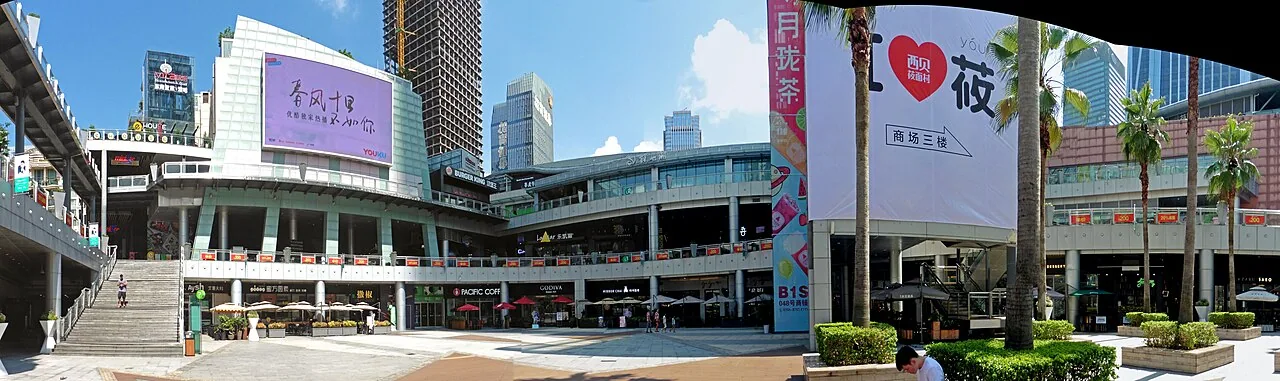
COCO Park (购物公园) sits above Shopping Park station on Lines 1 and 3 and is the standing answer to “where shall we meet”. Shops and restaurants by day; terraces and late bars at the eastern end after work. From about nine on a Friday it is one of the busiest nightlife blocks in the city, and on a Tuesday it is nothing at all. Central Walk (中心城) is two stops west at Convention and Exhibition Center station (Lines 1 and 4) — quieter, better for a straightforward dinner, and attached to the Shenzhen Book Mall, which is enormous and keeps a decent English section.
UpperHills
UpperHills (深业上城) is on the eastern edge of the CBD, up against Bijiashan Park, and it is where I send people who find the CBD sterile. The lower LOFT level is a lane of small restaurants and bars built to look vaguely European; the towers above hold a luxury hotel and several of the city’s more serious kitchens. There is no station directly underneath, so check the walking route before you set out rather than assuming the pin drops you at the door.
The Convention and Exhibition Center
One clarification worth forty minutes of your life. The Shenzhen Convention and Exhibition Center (深圳会展中心) is the older, central venue here in Futian. Shenzhen World (深圳国际会展中心) is a vastly larger site out in Bao’an, near the airport. Read which one your badge says before you order a car.
Living here: rent bands and reality
Treat every figure below as a broad estimate. Shenzhen rents move, and the floor, the age of the building, the furnishing and how hard you negotiate all matter more than any district average.
- Studio or small one-bedroom in an older block near the CBD: roughly ¥4,000–7,000 a month.
- Modern two-bedroom within walking distance of a CBD station: roughly ¥9,000–16,000.
- Newer high-rises and serviced apartments around Xiangmi Lake and the CBD core: ¥18,000 and comfortably upwards.
- Xiasha, Shangsha, Meilin and the northern edges: often well below the equivalent CBD figure for the same floor area.
Agency fees in Shenzhen are commonly around one month’s rent and are sometimes split with the landlord, so ask who pays at the first viewing. The deposit arrangement you will see most often is two months held plus one month paid in advance — written 押二付一 — though both the deposit and the payment cycle are negotiable. The mechanics, and the clauses to argue about, are in my guide to renting an apartment in Shenzhen.
Who it suits
If you work in finance, law, government-facing business or anything that involves meeting people in towers, live in Futian and stop thinking about it. It suits families who want a short commute, several international and bilingual school options inside one district, and a hospital — the University of Hong Kong–Shenzhen Hospital is here — that is used to foreign patients. It suits anyone who crosses to Hong Kong more than once a month.
If Futian is on a family shortlist, compare international schools in Shenzhen before choosing a tower. A cross-district morning commute can erase the central-city convenience you are paying for.
Who it does not
Futian is expensive, loud, and has no coastline worth the name. The green is confined to parks you have to travel to. If you want a bay view and a slower Saturday, Shekou or Nanshan will make you happier. If budget is the binding constraint, Longhua or Bao’an give you far more flat for the money. And the pure CBD blocks empty out at weekends in a way that some people find restful and others find bleak — walk them on a Sunday morning before you decide which you are.
Noise is the complaint I hear most often from people who moved here and regretted it. Shennan Boulevard and Binhe Avenue are wide, fast roads, and the same flat is a different proposition on the 8th floor than on the 30th. View it in the evening, with the windows open.
Getting around
Futian is the best-connected district in the city and you will not need a car. Lines 1, 2, 3, 4, 7, 9, 10, 11 and 14 all touch it. Four interchanges are worth memorising:
- Gangxia North (岗厦北) — Lines 2, 10, 11 and 14, under a large light-filled hall. The most useful CBD interchange and the quickest route east.
- Chegongmiao (车公庙) — Lines 1, 7, 9 and 11. Four lines and long transfer corridors; allow more time than the app suggests.
- Futian (福田) — Lines 2, 3 and 11, sitting directly above the high-speed rail platforms.
- Convention and Exhibition Center — Lines 1 and 4, the workhorse for the CBD core.
Line 11 is the airport line and runs a paid business carriage at the front; Futian to Bao’an Airport is roughly 35 minutes. Taxis and DiDi are plentiful, but Shennan Boulevard at six in the evening is a car park and the metro will beat it almost every time. Have WeChat or Alipay working before your first ride, since both open the gates by QR code — the rest is in the metro guide.
Crossing to Hong Kong
Two of Futian’s strongest arguments are underground.
Futian Station (福田站) is the mainland end of the Guangzhou–Shenzhen–Hong Kong high-speed line. Trains reach Hong Kong West Kowloon in roughly fifteen minutes; you clear mainland exit formalities at Futian and Hong Kong immigration on arrival. It runs north as well — Guangzhou in well under an hour, and long-distance services across the country. Book with the passport you intend to travel on, and arrive earlier than you would for a domestic train. Whether you need a visa or permit for the Hong Kong side depends entirely on your nationality and your mainland status, and those rules are not settled reading — confirm with the Hong Kong Immigration Department before you buy a ticket.
Futian Checkpoint (福田口岸) is the walking crossing, at the southern end of both Line 4 and Line 10. You cross on foot into Lok Ma Chau Spur Line station and pick up Hong Kong’s East Rail Line. It typically runs from early morning until around half past ten at night, but hours have changed before — confirm on the official Shenzhen government or Hong Kong Immigration Department page if you are cutting it fine.
Huanggang Port (皇岗口岸) is also in Futian, with its own metro station on Line 7, and is being rebuilt around a single combined inspection hall rather than two. To be plain about it: the rebuilt port has not opened, no opening date has been announced by either government, and it is not accepting passengers — so do not plan a crossing around it. Use Futian Checkpoint instead. I have written about separately what the design would mean if and when it does open.
Eating and drinking
Futian’s food splits three ways, and it helps to know which one you are in the mood for before you start scrolling.
The expensive end is genuinely good, and mostly sits inside hotels and at UpperHills — the tasting menus I would actually book are on the restaurants page, and the towers they occupy are on the hotels page. Reserve a week ahead for a weekend table.
The middle is malls: COCO Park, Central Walk, One Avenue, and the podium floors of half the office towers. Reliable, air-conditioned, rarely memorable, and how most people here eat on a Wednesday.
The interesting end is Xiasha (下沙). Two stops from the CBD, a former village of narrow lanes with seafood tanks, Chaoshan beef hotpot, late-night barbecue and prices a fraction of what the same food costs thirty floors up. It is also the home of the Xiasha poon choi (大盆菜) banquet held around Lantern Festival. Go hungry, go with someone who reads Chinese, and pick the restaurant on Dianping rather than an English map app — the English listings here point to the wrong branch more often than not.
If you are arriving with a lease to sign and one week to do it in, that is the sort of week I run for people professionally — relocation days start at around ¥1,500.
Work with me