Last verified:
Qianhai is the newest piece of Shenzhen you can stand in. Most of it did not exist thirty years ago — the land was dredged out of the bay, the roads were drawn before anyone lived on them, and the towers have gone up in a rough order you can still read off the skyline. It is the most planned place in a city that already feels planned, and how you feel about it depends almost entirely on what you came for.
What Qianhai actually is
The formal name is the Qianhai Shenzhen–Hong Kong Modern Service Industry Cooperation Zone (前海深港现代服务业合作区), set up in 2010 on roughly fifteen square kilometres of reclaimed land in western Nanshan. In 2021 the zone was enlarged to something closer to 120 square kilometres, taking in parts of Bao’an including the airport area and the convention centre.
That expansion matters when you read anything about the place, because “Qianhai” now means two different things. There is Qianhai the policy area, which is enormous and mostly not walkable, and there is Qianhai the district — the compact grid of new towers, parks and malls around Guiwan and Qianwan, ten minutes west of Nanshan. This page is about the second one.
The pitch to companies is regulatory rather than geographic. Qualifying businesses in the encouraged-industries catalogue can access a reduced corporate income tax rate, there is an individual income tax subsidy aimed at overseas — in practice largely Hong Kong and Macao — professionals, and a legal layer that allows some contracts with a genuine Hong Kong connection to choose Hong Kong law and Hong Kong-style arbitration. All of that is genuinely useful and all of it is conditional. The catalogues get revised, and eligibility is assessed line by line. Take the current wording from the Qianhai Authority at qh.sz.gov.cn and, if money depends on it, from a lawyer.
Very few people register a company here unaided. Most work through a local secretarial or agency firm, and the process turns on whether your business scope maps onto the encouraged list. Budget more time than you think for that single question.
How the district is laid out
Three sub-areas, named after bays. Guiwan (桂湾) in the north-east is the financial core and the densest part — the office towers, the Conrad, the malls, most of the people. Qianwan (前湾) sits west and south of it, newer and noticeably emptier, aimed at professional services and technology. Mawan (妈湾) is port and logistics, and is not somewhere you visit.
The towers are the obvious thing. Guiwan has gone from empty plots to a real skyline in about a decade, and it is still going up: finished towers sit next to hoardings and cranes. Completion dates for the buildings still under construction move, so treat any date you read as provisional until the doors are actually open. That is the honest pattern here — the plan is public, the timeline slips.
What surprises visitors is the scale of the street grid. Blocks are enormous, avenues are eight lanes wide, and a walk that looks like two minutes on a map is often eight. Wind comes straight off the bay. On a hot afternoon there is very little shade.
The places worth your time
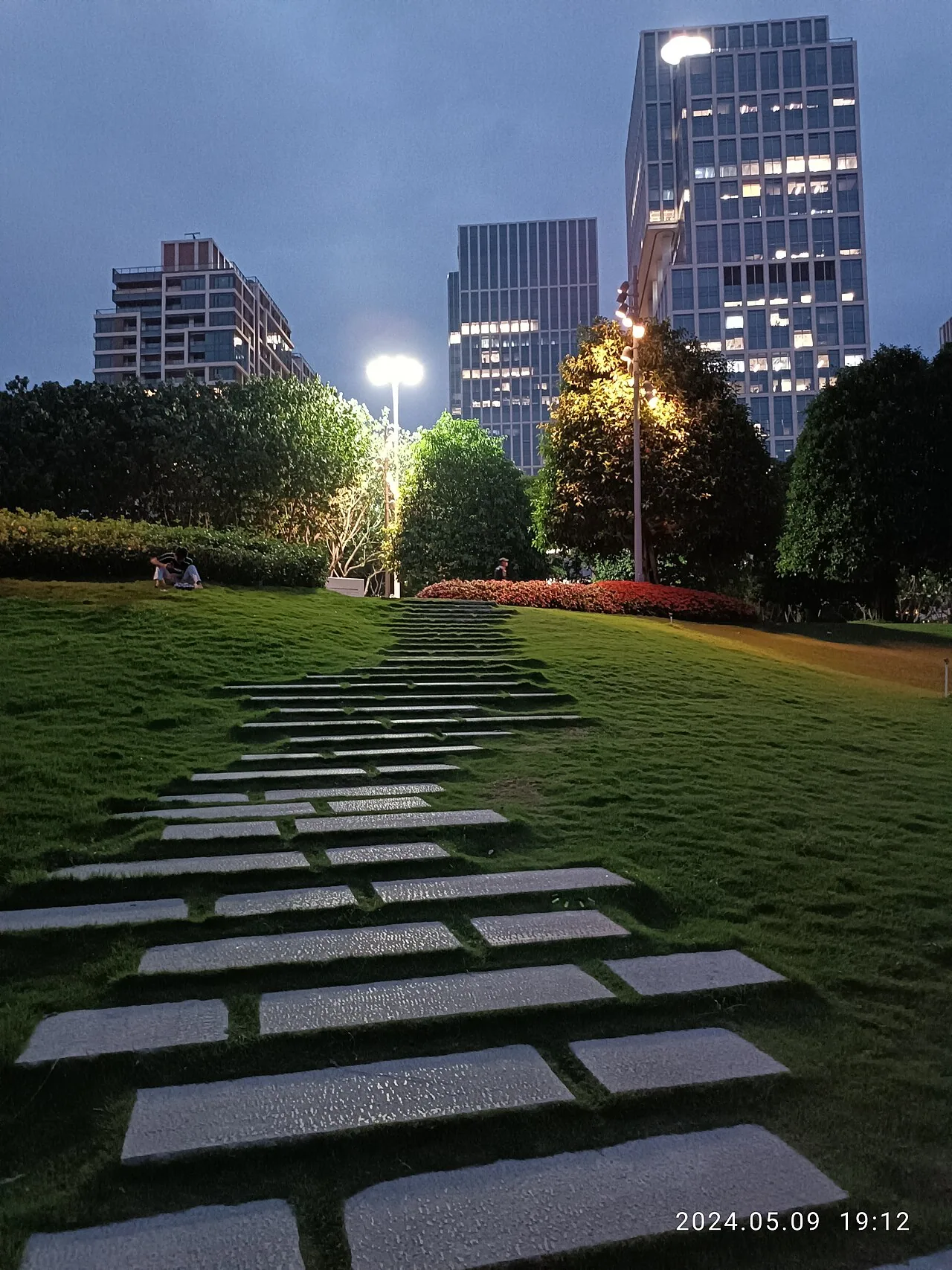
The waterfront is the reason to come if you are not here on business. Qianhai Stone Park (前海石公园) sits at the end of Qianhai Boulevard, built around an inscribed boulder that has become the district’s photo stop, and it opens onto a long promenade (海滨长廊) looking across the bay. Go for the last hour of daylight and stay while the towers switch on. After rain, when the haze drops, it is one of the better skyline views in the city.
- Guiwan Park (桂湾公园) and the Qianhai Performance and Arts Park (前海演艺公园) are separate places with a long walk between them. Pick one before you set off rather than trying to link them on foot.
- MixC Qianhai (前海万象城), near Qianhaiwan station, is the design-led mall and the most likely place to find a dinner you would travel for. It is not MixC Shenzhen Bay in Houhai, and not the original MixC in Luohu.
- Qianhai Yi Fanghui (前海壹方汇), about 320 metres from Guiwan station Exit E, is the everyday mall — lunch, a pharmacy, a haircut, a coffee between meetings. Do not confuse it with Uniwalk (壹方城) beside Bao’an Center, which is a far bigger complex a few metro stops north.
- Conrad Shenzhen, on Tinghai Avenue, is the default for a meeting, a business lunch or a quiet drink. More on the hotels page.
There is also a planning exhibition hall near the stone, which is worth twenty minutes if you want to understand what the district is supposed to become. Opening arrangements and advance-booking rules change, so check before making a special trip.
Living here — and who it is wrong for
The residential stock is almost entirely new-build, and that is the honest selling point. Flats delivered in the past few years come with lifts that work, underground parking, proper gyms, decent glazing and sound insulation. Walk from a 2000s Futian tower into a Guiwan one and the difference is obvious in the lobby.
Rents move constantly, so take these as broad bands rather than quotes. A one-bedroom or small two-bedroom in a newer block tends to sit somewhere around ¥5,500–9,000 a month; a family-sized three-bedroom in the better Guiwan buildings is more like ¥13,000–22,000. Serviced apartments attached to the office towers run above that. Purchase prices I will not put a number on: Guiwan new-build sits at the upper end of the Shenzhen range, it moves with policy, and the spread between towers, floors and views is wide enough that any single figure would mislead you. Work from the recorded price (备案价格) for the specific building and from recent completed transactions, not from asking-price listings. Some buildings also carry talent housing (人才住房) allocations, which depend entirely on your employer and your status.
Now the part the brochures leave out. Because this is reclaimed land, Qianhai has no urban villages (城中村). There is no accumulated mess of noodle floors, wet-market lanes, phone-repair stalls and family restaurants that gives older Shenzhen its texture, because there was never a village here to become one. Everything is a mall unit or a tower lobby. Ground-floor retail in several podiums is still empty or leased to banks and showrooms. At ten at night, large stretches of pavement are simply quiet.
Some people find that restful — the air is better, the streets are clean, nothing is crowded. Others find it sterile within a month. The only reliable test is to spend a weekday evening walking around the specific block you are considering, at the hour you would actually be walking around. Do that before you sign anything; the mechanics of the lease itself are covered in my guide to renting an apartment in Shenzhen.
Ask which plots near your building are still under construction, and get it in writing if you can. Several blocks remain active sites. The difference between a finished street and one with three cranes on it is measured in months of sleep.
Getting around
Qianhaiwan (前海湾) is the anchor station, where Lines 1, 5 and 11 meet. Guiwan (桂湾) on Line 5 drops you in the financial core, and Line 9 runs west to end at Qianwan (前湾), where it meets Line 5 again. For the parks, Guiwan and Menghai are the two useful starting points — choose which park first, because they are not close together.
The single strongest argument for living here is the airport. From Qianhaiwan, Line 11 reaches Bao’an Airport in three stops and roughly fifteen minutes. Nowhere else that feels central is anywhere near that. Line 11 also runs a business carriage with a surcharge, which is usually worth it with luggage. Do not try to reach the airport on Line 1 — its western terminus, Airport East, is a legacy station and not where the terminals are. The rest of the network is covered in my Shenzhen metro guide.
Going east, Line 1 gets you into Futian in about thirty-five minutes and Luohu in closer to fifty. For Hong Kong, the nearest crossing is Shenzhen Bay Port (深圳湾口岸), around twenty minutes by car off-peak and considerably longer on weekend mornings and around public holidays. Huanggang (皇岗口岸) sits across the city in Futian and is being rebuilt around a single joint inspection hall; that rebuilt port has not opened, no opening date has been announced, and it is closed to the public — so do not plan a late return around it. The detail is in the Huanggang note. Border rules, opening hours and lane arrangements all change; confirm on the official Shenzhen government and Hong Kong Immigration Department pages before you build a schedule around them.
Eating and drinking
This is where Qianhai is thin, and pretending otherwise would waste your time. The food is concentrated in the malls and the hotels: Yi Fanghui for a weekday lunch, MixC Qianhai for a proper dinner, the Conrad for hotel dining and a drink that does not involve going home first. It is improving year on year, but the gap against Futian or Houhai is still large.
What residents actually do is leave for dinner. Shekou is fifteen to twenty minutes by car and has the bars, the terraces and the international restaurants; Nanshan, especially around Houhai, has the range. At weekends there has been a free Qianhai–Shekou cultural shuttle running — check whether it is operating before you rely on it. Northwards, Bao’an is close enough that Bao’an Center is a genuine option.
Delivery covers everything, as it does everywhere in this city, and the large supermarkets in the malls handle the weekly shop. If groceries matter to you, check which chains deliver to your specific compound before you assume.
Work with meWhere you would actually go if someone is ill
Qianhai is new enough that this question has only recently had a good answer inside the zone.
Shenzhen Qianhai Taikang Hospital 深圳前海泰康医院 — private tertiary general hospital on Menghai Avenue, inside the cooperation zone. It is the only full general hospital physically in Qianhai, and it runs a 24-hour emergency department and inpatient wards — a short taxi rather than a cross-city drive.
Southern Medical University Shenzhen Hospital 南方医科大学深圳医院 — Grade-A tertiary teaching hospital on Xinhu Road, immediately north in Bao’an, with round-the-clock emergency registration. The nearest top-grade public hospital to the Qianhai core.
Shenzhen Qianhai Shekou Free Trade Zone Hospital 深圳市前海蛇口自贸区医院 — tertiary — and despite the name, it is in Shekou, not Qianhai. The best-documented hospital in the city for foreign patients, and where most Qianhai residents end up for non-emergencies.
Nanshan District People’s Hospital 深圳市南山区人民医院 — Grade-A tertiary, roughly twenty minutes east of Guiwan by taxi, and the district’s flagship.
How healthcare works here, in full.
Schools in and around the zone
Qianhai’s schools are worth reading carefully, because the admissions categories are where most guides go wrong. Three legal categories exist, and they are not interchangeable.
Harrow International School Shenzhen Qianhai 深圳前海哈罗外籍人员子女学校 — the English National Curriculum from Early Years through Senior School. Admissions are mixed, not foreign-passport-only — foreign passport holders, and holders of Hong Kong, Macao or Taiwan status. That distinction decides eligibility and is routinely misreported.
Harrow Hong Kong Children School Shenzhen Qianhai 深圳前海哈罗港人子弟学校 — a 港人子弟学校 — a third category, neither a foreign-passport school nor a mainland bilingual one, teaching the Hong Kong curriculum with Hong Kong materials.
Within reach to the south and east: Shekou International and BASIS, plus QSI and the International School of Nanshan — all foreign-passport schools, with the Hong Kong, Macao and Taiwan exception. The eight compared, with fees.