Last verified:
Bao’an is the part of Shenzhen most people pass through without stopping. It holds the airport, the exhibition centre, an enormous amount of light manufacturing, and — over the last decade — a rebuilt civic core and a stretch of coast that is genuinely worth an evening. If you are choosing where to live, this is the district that gives you the most floor space per yuan and asks for your commute in return.
What the district is, and how it feels
Bao’an (宝安区) runs up the western coast of Shenzhen from the Qianhai boundary to the Dongguan border. It is large — larger than Futian, Luohu and Nanshan combined — and it does not have one centre so much as several, strung along the metro and the coast road.
The south end, around Bao’an Centre, is the polished part: wide boulevards, towers from the last fifteen years, government buildings, a library and art museum, and the waterfront a short ride away. Head north through Xixiang (西乡), Fuyong (福永), Shajing (沙井) and Songgang and the character changes: older residential blocks, urban villages, wholesale markets, and industrial parks that still make a great deal of what the world buys. It is not scenic in those parts. It is, however, functional, cheap and very much alive.
The honest summary is that Bao’an feels like a Chinese city rather than an international enclave. That is a feature or a problem depending on why you are here.
The airport, and living beside it
Shenzhen Bao’an International (SZX) is the district’s defining asset. Terminal 3 — the one with the perforated white shell, opened in 2013 — handles almost everything, with a satellite concourse added at the end of 2021 and further expansion work under way on the airfield. If you fly more than twice a month, living in Bao’an turns a cross-city trek to the terminal into a short local hop, and that saving adds up faster than you expect.
The airport trap
Metro Line 1 terminates at a station called Airport East (机场东). It is not at the terminal. It is a legacy stop several kilometres away, and you finish the journey on a shuttle bus. For flights, take Line 11 to Airport (机场) instead — that one delivers you inside Terminal 3. I have watched more than one visitor discover this with nothing like enough time to spare.
Line 11 also runs a business carriage at one end of the train, with wider seats and room for luggage. It costs a multiple of the standard fare and is worth it when you are travelling with bags. If you are still working out how the network fits together, the Shenzhen metro guide covers fares, apps and the transfer logic.
Fuyong also has a ferry terminal beside the airport, with services that have historically run to Hong Kong International Airport, Macau and Zhuhai — the Hong Kong route has at times allowed connecting passengers to transfer without clearing immigration, but the conditions attached to that have changed more than once. Those routes have also been suspended and restored repeatedly, so confirm the current schedule and rules with the operator and the official port notices rather than trusting an old blog post.
Shenzhen World Exhibition and Convention Center sits in Fuyong, north of the airport, and is one of the largest exhibition venues in the world by indoor hall space. If your work involves trade fairs, Bao’an puts you on the right side of the city for both the halls and the flights.
Bao’an Centre and the waterfront
Bao’an Centre (宝安中心) is where the district makes its case. The metro interchange between Lines 1 and 5 sits under a cluster of malls, offices and the civic and cultural buildings — library, art museum, performance venues — that give the area a proper centre of gravity rather than just shops.
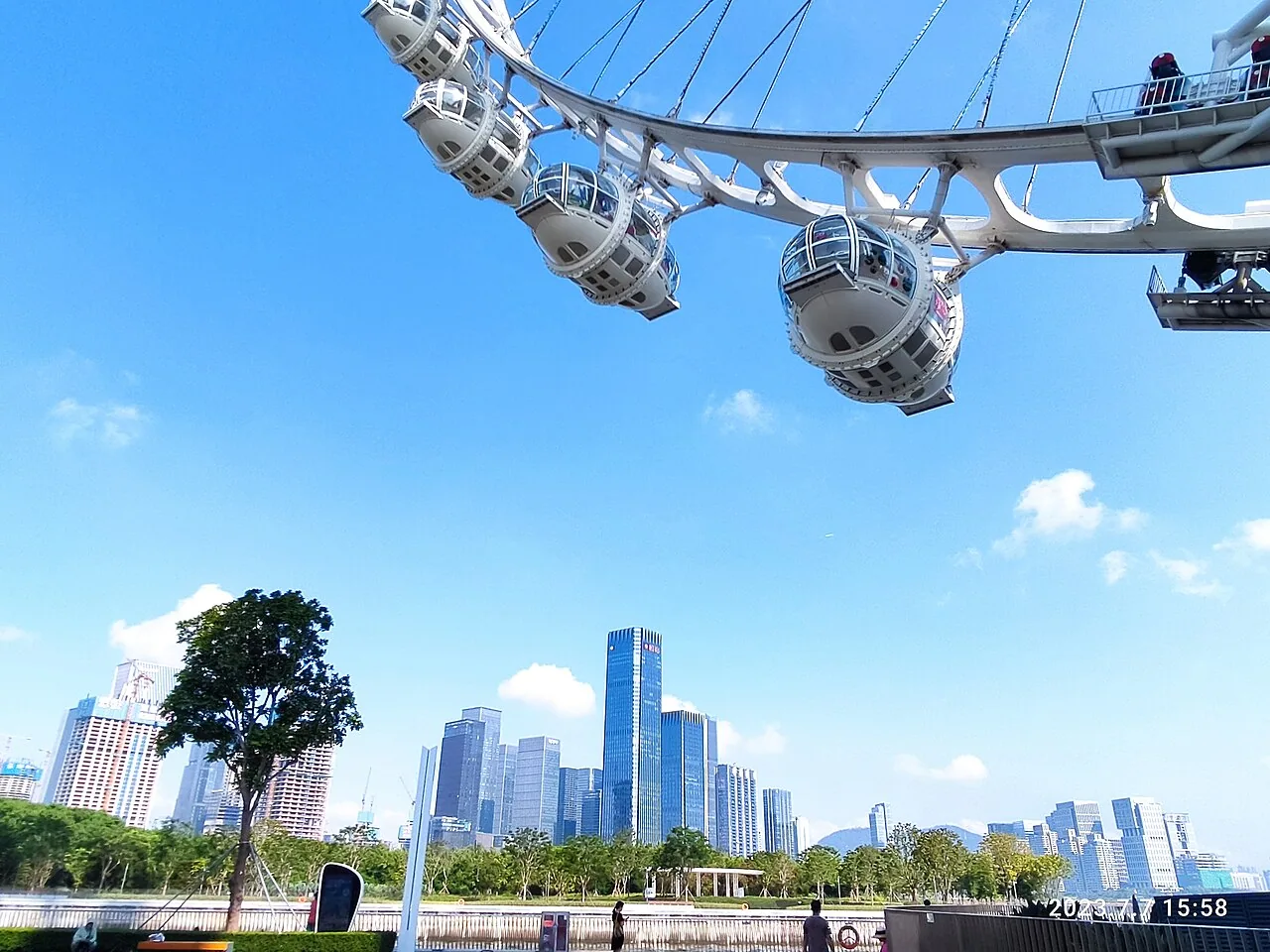
Fifteen minutes west, the coast is the real draw. OH Bay (欢乐港湾) opened in 2021 and joins Haibin Culture Park (海滨文化公园) into one long waterfront: lawns, a canal, restaurants, and the Bay Glory ferris wheel (湾区之光) turning slowly above it at around 128 metres, which makes a full rotation a leisurely business rather than a quick ride. Tickets are sold through a WeChat mini-programme with different tiers of cabin, and both prices and operating hours change, so check the current listing before queueing — and if you have not set that up yet, start with WeChat and Alipay.
There is an evening light-and-water show along the waterfront on a published schedule. Times shift with the season and it does not run in bad weather, so confirm on the day rather than travelling across the city on spec. The promenade itself continues in both directions and is one of the better flat runs or cycles in Shenzhen — quieter than Shenzhen Bay Park, with the sunset in the right place.
For malls: Uniwalk, next to Bao’an Centre station, is the big one — and it is the same building as 壹方城, which is simply its Chinese name. Do not confuse it with the much smaller Qianhai Yi Fanghui (前海壹方汇) over in Guiwan. Haiya Mega Mall (海雅缤纷城) in Xixiang serves the older residential blocks further north.
Living here: what you gain and what you pay
Rent, honestly
Treat every figure below as a broad estimate — it moves with the building, the floor, the age of the compound and the month you look.
- Around Bao’an Centre: expect roughly ¥3,500–6,500 a month for a two-bedroom in a managed compound; ¥6,000–9,500 for something newer, larger or with a sea view.
- Xixiang, Fuyong, Shajing: the same money buys noticeably more. Two-bedrooms typically start around ¥2,500, and family-sized flats sit where a one-bedroom would in Nanshan.
- For comparison: equivalent space in Houhai or the Futian CBD usually runs somewhere between half again and double these numbers.
That gap is the entire argument for Bao’an, and it is a strong one if you need three bedrooms and a study rather than a shoebox with a good address. The mechanics of signing — deposit structure, agent fee, the paperwork you need for your residence registration — are broadly the same citywide, though individual police stations and landlords ask for slightly different documents and the requirements do change, so confirm with the official source for your address. They are covered in renting an apartment in Shenzhen.
Before you commit, ride the actual commute at 8am on a weekday, not at noon on a Saturday. Line 1 eastbound from Bao’an is standing-room from early on, and forty-five minutes on paper feels considerably longer in practice.
Getting around
Four lines carry most of the load. Line 1 runs the length of the district and on into Nanshan and Futian — comprehensive, but it stops everywhere. Line 5 loops east and north, meeting Line 1 at Bao’an Centre. Line 11 is the fast one: fewer stops, airport included, and roughly half an hour into Futian from the western corridor. Line 12 opened in late 2022 and connects the Shekou side of Nanshan northwards through Bao’an towards Shajing, which quietly made a lot of northern Bao’an viable for people working in the south-west.
Reckon on the better part of an hour from Bao’an Centre to the Futian CBD on Line 1, and roughly half that to Houhai — both are rough estimates that depend on where in the district you start, so ride them yourself before you decide. Driving is often no faster in peak hours, but Bao’an is one of the few districts where parking is neither scarce nor punishing, and a car genuinely changes the experience of living here.
For Hong Kong, your practical crossing is Shenzhen Bay Port to the south — reckon on a little over half an hour by car from Bao’an Centre in normal conditions, longer in traffic. The rebuilt Huanggang port over in Futian has not opened and no date has been announced for it, and in any case it sits a long way east and is rarely worth the detour from here. Opening hours, permit requirements and which lanes are open change without much warning, so confirm with the official border authority before you plan a crossing.
Eating and drinking
The food is very good and very Chinese. Shajing is historically known for its oysters (沙井蚝) and the seafood restaurants in the north still trade on it. Xixiang’s older streets do the best cheap eating in the district — Chaozhou, Hakka, Hunan, night-market skewers — at prices that would look like a misprint in Shekou.
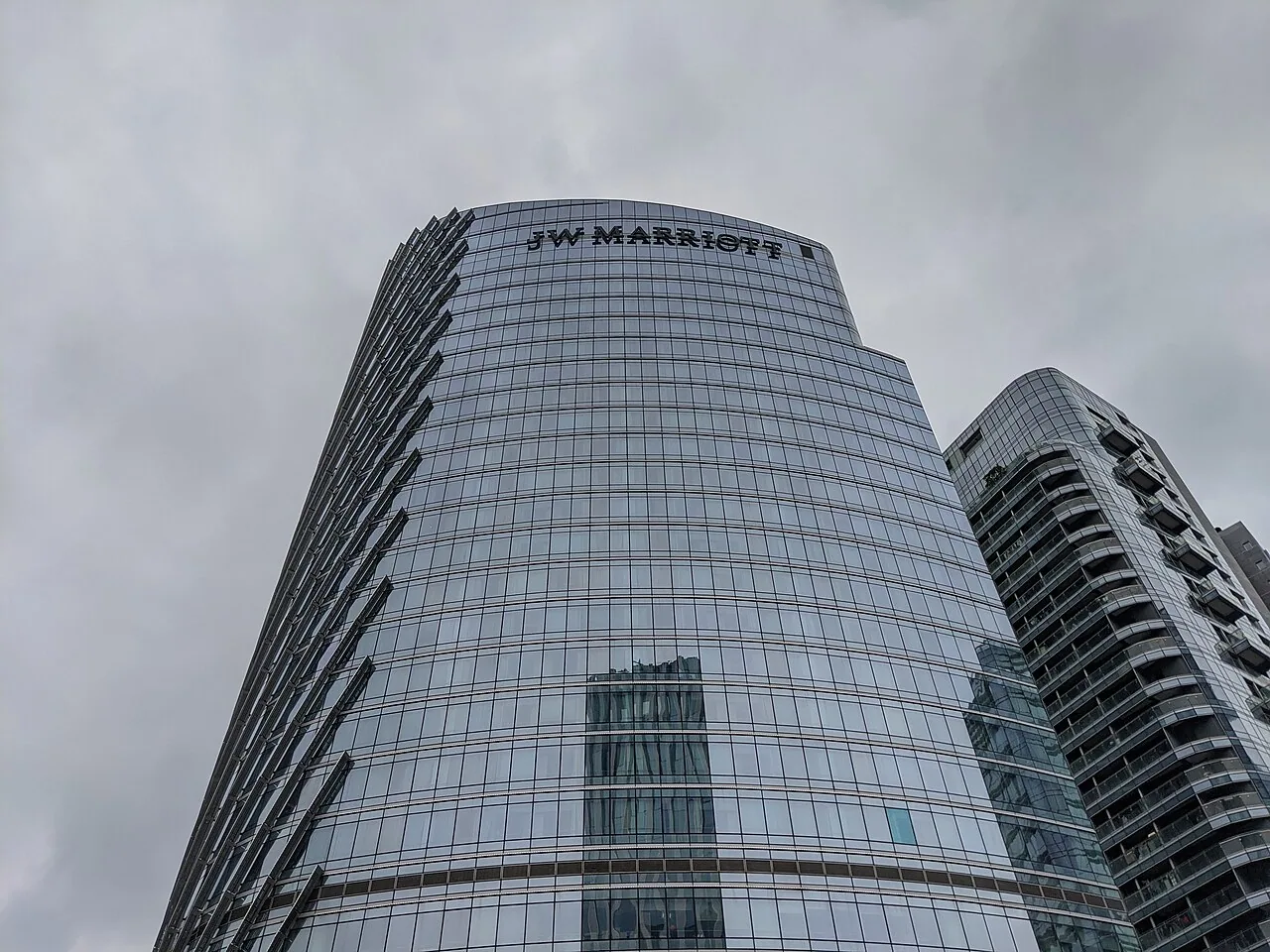
Around Bao’an Centre and OH Bay you get the newer end: mall restaurants, waterfront terraces, hotel dining at the JW Marriott, and a small number of western bars and cafés that the district’s foreign community uses as its regular meeting points. There are far fewer of them than in Shekou and they turn over, so ask around when you arrive rather than working from someone else’s list.
Be honest with yourself about the gap, though. Compared with Shekou or Houhai, Bao’an is thin on specialist international food, natural wine, third-wave coffee and English-speaking service. You will eat extremely well and pay less. You will also travel east when you want a particular kind of evening.
Who it suits — and who it does not
Who it works for
Bao’an works well for frequent flyers, for families who want a fourth bedroom and a park instead of a CBD postcode, for anyone whose work sits in manufacturing, logistics or the exhibition trade, and for people who would rather spend less on rent than less on time. It also suits drivers.
What is not here
It works badly if you need international schools or English-speaking healthcare close to home — most of both remain in Shekou, Nanshan and Futian, and a school run from Bao’an is a real commitment. It works badly if you want a walkable neighbourhood: the district is built at car scale, and the distance between two things that look adjacent on a map is often a fifteen-minute walk across a boulevard. And if your social life is in Shekou, you will spend a lot of evenings on the last train.
The compromise worth considering is the southern edge, where Bao’an meets Qianhai. You keep most of the price advantage, you are far closer to Nanshan, and the new development along that boundary is filling in quickly.
If you want a second opinion before you commit to a lease or a purchase out here, I do relocation days where we ride the commute, walk three or four compounds and talk about what the agent is not telling you.
Work with me